
Discover what backend development is, how it works, and the core technologies you need to master. A complete guide for beginners and aspiring developers.
What is Backend Development? The Ultimate Guide to the Engine Room of the Web
Imagine walking into a high-end restaurant. You see the elegant decor, the polished silverware, and the friendly waiter who takes your order. This is the Frontend—everything you see and interact with.
But behind those swinging double doors is a chaotic, high-energy kitchen. There are chefs, sous-chefs, prep stations, and a pantry full of ingredients. Without that kitchen, the restaurant is just a room with empty tables.
In the digital world, that kitchen is Backend Development.
In this comprehensive guide, we are going to pull back the curtain on the “server-side” of the internet. Whether you are a total beginner or a frontend dev looking to bridge the gap, you’re about to learn exactly how the magic happens behind the scenes.
What is Backend Development?
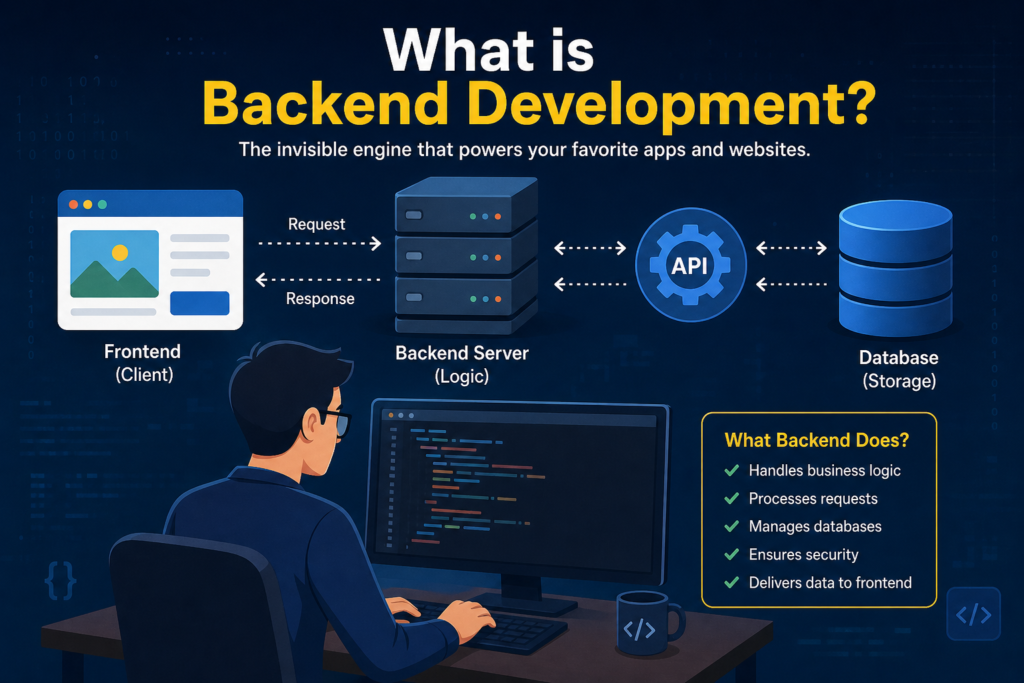
At its simplest, backend development is the practice of building and maintaining the “invisible” side of a website or application. While frontend developers focus on what a user clicks and sees, backend developers focus on the logic, databases, and servers that make those actions possible.
Every time you log into Instagram, check your bank balance, or buy a pair of shoes on Amazon, you are interacting with a backend.
The Three Pillars of the Backend
To understand backend development, you need to understand its three core components:
- The Server: A powerful computer that “serves” data to your browser.
- The Application: The code (written in languages like Python or Node.js) that tells the server what to do.
- The Database: The organized digital filing cabinet where all your information is stored.
Why is Backend Development Important?
Without the backend, the internet would just be a collection of “static” pages—like digital brochures. You could read them, but you couldn’t do anything.
Backend development allows for:
- Data Persistence: Saving your profile, your posts, and your progress.
- Security: Verifying that you are who you say you are (Authentication).
- Business Logic: Calculating taxes on an e-commerce order or matching you with a driver on Uber.
- Scalability: Ensuring a site doesn’t crash when 10,000 people visit at once.
Core Concepts: How the Backend Works
Let’s break down the technical process into bite-sized pieces.
1. The Request-Response Cycle
Everything starts with a Request. When you type www.google.com and hit enter, your browser (the client) sends a request to a server.
The server receives this request, processes it (the backend logic), and sends back a Response. This response usually includes the HTML, CSS, and data needed to show you the page.
2. APIs (The Messengers)
API stands for Application Programming Interface. Think of an API as the waiter in our restaurant analogy. The waiter takes your order (the request) to the kitchen (the backend) and brings your food back to the table.
APIs allow different pieces of software to talk to each other. For example, when a travel site shows you flight prices from five different airlines, it’s using APIs to pull that data from the airlines’ backends.
3. Databases and Data Management
A backend developer must know how to store data efficiently. There are two main types of databases:
- Relational (SQL): Think of these like Excel spreadsheets. Data is organized into tables with rows and columns (e.g., PostgreSQL, MySQL).
- Non-Relational (NoSQL): These are more like folders filled with documents. They are flexible and great for large, unstructured data (e.g., MongoDB).
The Backend Tech Stack
To become a backend developer, you don’t need to know every language, but you should master one “stack.”
Popular Backend Languages
- Python: Loved for its simplicity and readability. Great for AI and data science (Frameworks: Django, Flask).
- JavaScript (Node.js): Allows you to use the same language for both frontend and backend.
- Ruby: Known for developer happiness and speed (Framework: Ruby on Rails).
- Java: The “granddaddy” of enterprise software. Highly secure and stable (Framework: Spring).
- Go (Golang): Built by Google for high performance and concurrency.
💡 Pro Tip: If you are a complete beginner, start with Python or Node.js. They have massive communities and excellent documentation.
Practical Example: A Simple Backend Script
Let’s look at a very basic example using Node.js and Express (a popular backend framework). This code creates a server that says “Hello, Backend!” when you visit it.
// Load the Express library
const express = require('express');
const app = express();
const PORT = 3000;

// Define a "Route"
// When someone visits the home page (/), this function runs
app.get('/', (req, res) => {
  res.send('Welcome to the Engine Room: Hello, Backend!');
});

// Start the server
app.listen(PORT, () => {
  console.log(`Server is running on http://localhost:${PORT}`);
});
In this example, the backend logic is simply sending a string of text. In a real app, this logic might involve checking a database for a user’s name or processing a credit card payment.
Common Mistakes to Avoid
- Ignoring Security: Never trust user input. If you don’t sanitize the data users type into forms, your database could be deleted via an SQL Injection attack.
- Over-Engineering: Don’t build a complex microservices architecture for a simple blog. Start simple.
- Poor Documentation: If you don’t document your API, other developers (including your future self) will have no idea how to use it.
- Neglecting Performance: If your database query takes 5 seconds to run, your users will leave. Learn about Indexing.
Pro Tips for Aspiring Developers
Learn to Love the Terminal
Backend developers spend a lot of time in the command line. Master basic Linux commands; it will make you feel like a wizard and significantly speed up your workflow.
Understand HTTP Status Codes
You’ve seen a 404 Not Found error, but do you know what a 201 Created or a 500 Internal Server Error means? Knowing these codes is essential for debugging.
Focus on Logic, Not Just Syntax
Languages change, but logic is forever. Understanding how data structures (like arrays and objects) and algorithms work is more important than memorizing the specific keywords of Python or Java.
Real-World Use Cases
1. E-commerce (The Shopping Cart)
When you add an item to your cart, the backend checks the database to see if the item is in stock. It then reserves that item for you so no one else buys the last one while you’re checking out.
2. Social Media (The Algorithm)
The backend is responsible for your “Feed.” It looks at who you follow, what you’ve liked in the past, and uses an algorithm to decide which post to show you next.
3. Banking (Security)
Backend systems handle the heavy lifting of encryption. When you transfer money, the backend ensures the transaction is “Atomic”—meaning either the whole transfer happens successfully, or none of it happens at all. No money should ever disappear into thin air.
Mini Project: Build Your First API Plan
You don’t need to write code yet to start thinking like a developer. Try to map out the backend for a Task Management App (like Trello).
- Define your Data: What do we need to store? (Users, Boards, Tasks, Comments).
- Define your Endpoints:
- POST /register (To create a user)
- GET /tasks (To see all tasks)
- DELETE /tasks/1 (To remove a task)
- Pick your Database: Since tasks have a clear relationship to users, a SQL database like PostgreSQL would be a great choice.
Frequently Asked Questions (FAQs)
1. Is backend harder than frontend?
It’s not necessarily “harder,” but it is different. Frontend is visual and requires an eye for design. Backend is logical and requires an interest in data, architecture, and “how things work” under the hood.
2. Do I need a degree to be a backend developer?
Absolutely not. Many top-tier backend engineers are self-taught or come from bootcamps. What matters most is your portfolio and your ability to solve problems.
3. Which backend language should I learn first?
For 2026, Python remains the most beginner-friendly, while Node.js (JavaScript) is the most versatile if you want to become a “Full-Stack” developer.
4. What is the difference between a Server and the Cloud?
“The Cloud” is just someone else’s server. Instead of owning a physical computer in your closet, you rent space from companies like Amazon (AWS) or Google (GCP).
5. What is an ORM?
An Object-Relational Mapper (ORM) is a tool that lets you talk to your database using your preferred programming language instead of writing raw SQL. It makes life much easier!
Conclusion
Backend development is the foundation of the modern world. It is the invisible force that powers our apps, protects our data, and connects the globe. While it might seem intimidating at first, it is a deeply rewarding field that rewards curiosity and logical thinking.
The transition from a user to a creator starts with understanding that every button you click triggers a complex, beautiful dance of data in the background. Now that you know what backend development is, it’s time to stop reading and start building.
Ready to take the next step? Pick a language, set up your local environment, and try to build a simple “Hello World” server today. The internet is waiting for what you’ll build next.
Start practicing now!