
Python for Beginners: A Complete Guide to Start Programming with Confidence
Python has become one of the most popular and beginner-friendly programming languages in the world. Whether you want to build websites, automate tasks, analyze data, or explore artificial intelligence, Python provides a powerful and flexible foundation to achieve your goals.
For beginners, Python is often the best starting point due to its simple syntax and readability. Unlike many other programming languages, Python allows you to focus on understanding programming concepts without getting overwhelmed by complex rules.
In this guide, you will learn what Python is, why it is so popular, and how you can start using it to build real-world applications step by step.
What is Python?
Python is a high-level, interpreted programming language known for its simplicity and versatility. It was designed to be easy to read and write, making it an ideal choice for beginners.
One of Python’s key strengths is its clean and readable syntax, which often resembles plain English. This makes it easier to understand and reduces the learning curve for new programmers.
Python is widely used in many fields, including:
- Web development
- Data analysis
- Machine learning
- Automation
- Game development
Why Choose Python as a Beginner?
There are many reasons why Python is recommended for beginners:
1. Simple Syntax
Python code is easy to read and write, allowing you to focus on logic rather than complex syntax.
2. Large Community
Python has a massive global community, which means there are countless tutorials, forums, and resources available.
3. Versatility
You can use Python for almost anything—from simple scripts to advanced applications.
4. High Demand
Python developers are in high demand across many industries.
Installing Python
To start coding in Python, you need to install it on your computer.
Steps:
- Download Python from the official website
- Install it and ensure you check “Add to PATH”
- Verify installation using the command line
Once installed, you can start writing Python code using a simple text editor or an IDE.
Your First Python Program
Let’s start with a simple program:
print("Hello, World!")
This line of code tells Python to display text on the screen.
Basic Concepts in Python
To build a strong foundation, you need to understand the following concepts:
Variables
Variables are used to store data.
name = "ZeroToDev"
age = 1
Data Types
Python supports different types of data:
- String → “Hello”
- Integer → 10
- Float → 3.14
- Boolean → True / False
Conditions
Conditions allow your program to make decisions.
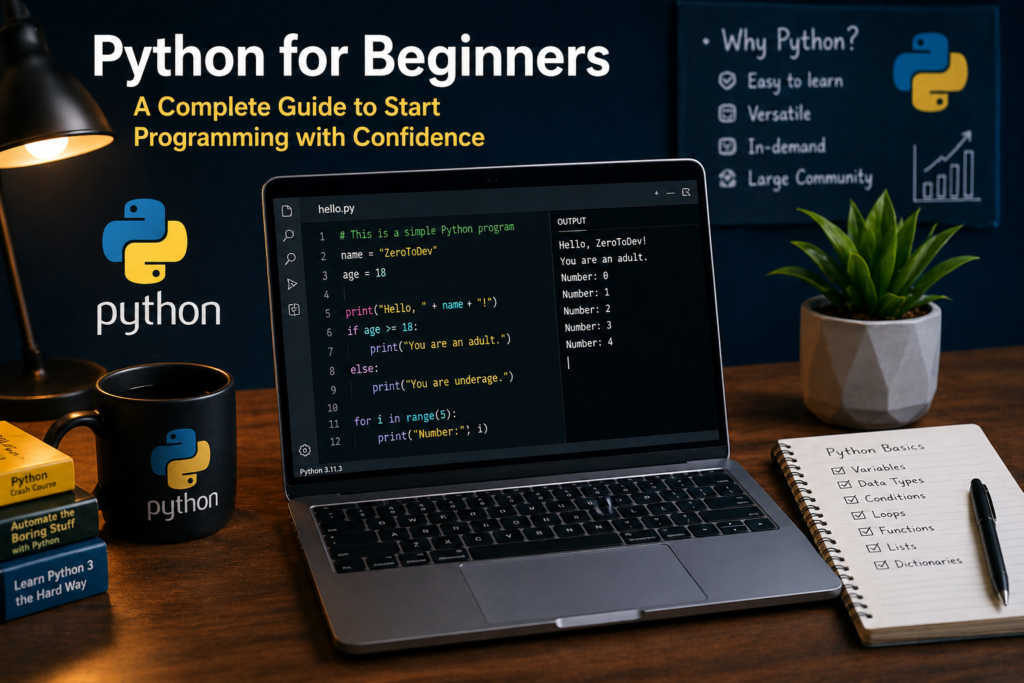
age = 18

if age >= 18:
    print("You are an adult")
else:
    print("You are underage")
Loops
Loops repeat actions.
for i in range(5):
    print(i)
Functions
Functions help you reuse code.
def greet():
    print("Welcome to ZeroToDev")

greet()
Lists
Lists store multiple values.
numbers = [1, 2, 3, 4, 5]
print(numbers[0])
Dictionaries
Dictionaries store data in key-value pairs.
user = {
    "name": "Ali",
    "age": 20
}
print(user["name"])
Why Practice is Essential
Reading Python tutorials is not enough—you need to write code regularly.
Practice helps you:
- Understand concepts deeply
- Improve problem-solving skills
- Build confidence
Start with small programs and gradually increase complexity.
Real-World Applications of Python
Python is used in many real-world scenarios:
Automation
Automate repetitive tasks like file handling or data entry.
Web Development
Build websites using frameworks like Django or Flask.
Data Analysis
Analyze and visualize data using libraries like Pandas and Matplotlib.
Artificial Intelligence
Develop machine learning models and intelligent systems.
Common Beginner Mistakes
- Forgetting proper indentation (very important in Python)
- Trying to memorize instead of understanding
- Skipping fundamentals
- Not practicing enough
Mistakes are part of learning—don’t be afraid of them.
Best Practices for Beginners
- Write clean and readable code
- Use meaningful variable names
- Practice daily, even for short periods
- Break problems into smaller parts
- Learn by building small projects
Building a Simple Python Project
Here is a basic example of a calculator:
num1 = int(input("Enter first number: "))
num2 = int(input("Enter second number: "))

sum = num1 + num2

print("Result:", sum)
This simple project helps you understand input, variables, and operations.
What Comes After Python Basics?
Once you master the basics, you can move to:
- Object-Oriented Programming (OOP)
- Working with APIs
- Building web applications
- Data science and machine learning
Python offers endless possibilities.
Why Python is the Future
Python continues to grow rapidly due to its simplicity and power. It is widely used by major companies and is a key language in emerging technologies.
Learning Python today is an investment in your future.
Conclusion
Python is one of the best programming languages for beginners. Its simplicity, flexibility, and wide range of applications make it the perfect starting point for your programming journey.
By learning Python step by step and practicing consistently, you can build real-world skills and open the door to countless opportunities in technology.
Stay consistent, keep learning, and continue your journey with ZeroToDev—from zero to developer.