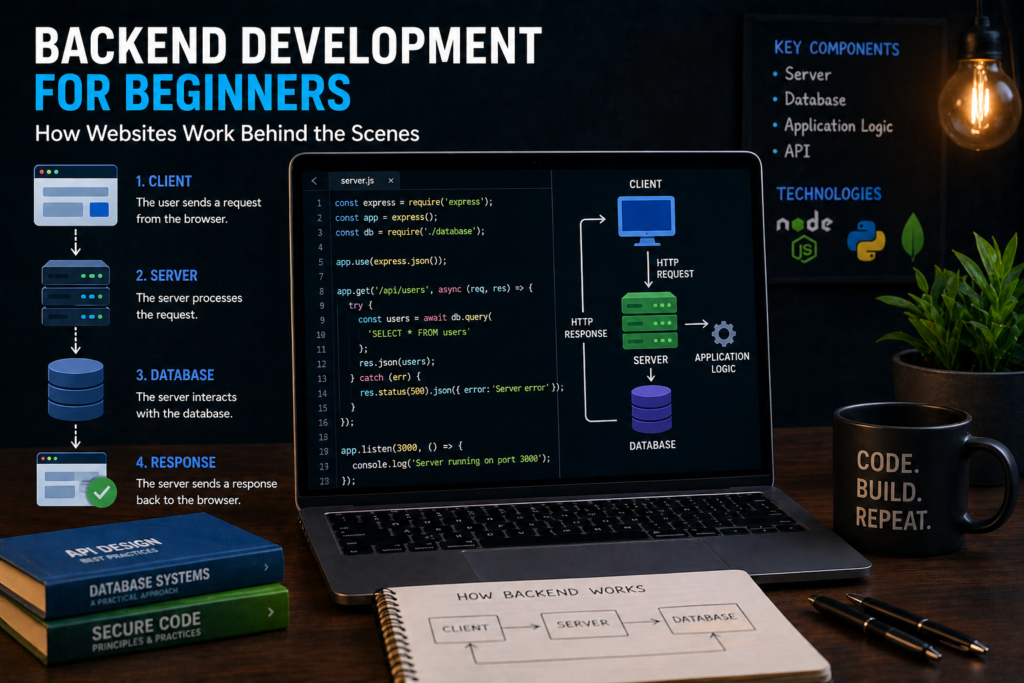

Backend Development for Beginners: How Websites Work Behind the Scenes
When you visit a website, what you see on the screen is only part of the story. Behind every modern website or application lies a powerful system that handles data, processes logic, and ensures everything works smoothly. This hidden layer is known as backend development.
While frontend development focuses on design and user interaction, backend development is responsible for everything that happens behind the scenes. It powers the functionality that users rely on every day—from logging into accounts to storing data and processing requests.
In this guide, you will learn what backend development is, how it works, and how you can start building your own backend systems from scratch.
What is Backend Development?
Backend development refers to the server-side of web development. It involves building and maintaining the systems that process data, manage databases, and handle application logic.
In simple terms, the backend is what makes a website functional.
For example:
- When you log into a website, the backend verifies your credentials
- When you submit a form, the backend processes and stores the data
- When you load a page, the backend retrieves information from a database
Frontend vs Backend
To understand backend development better, it is important to compare it with frontend:
- Frontend: What users see and interact with (HTML, CSS, JavaScript)
- Backend: What users do not see (servers, databases, logic)
Both parts work together to create a complete web application.
Key Components of Backend Development
Backend systems are built using three main components:
1. Server
The server is a computer that receives requests from users and sends responses back.
For example, when you open a website, your browser sends a request to the server, and the server responds with the website data.
2. Database
A database stores and organizes data.
Examples of data stored:
- User accounts
- Passwords
- Posts and content
- Application settings
Popular types of databases include relational (SQL) and non-relational (NoSQL).
3. Application Logic
This is the code that processes data and determines how the application behaves.
It handles:
- Authentication
- Data validation
- Business rules
- Communication between server and database
How Backend Works (Step by Step)
Let’s break down what happens when a user interacts with a website:
- The user sends a request (e.g., clicking a button)
- The request is sent to the server
- The server processes the request using backend code
- The server interacts with the database if needed
- The server sends a response back to the user
This entire process happens in milliseconds.
Popular Backend Languages
There are many programming languages used for backend development:
- Python (Django, Flask)
- JavaScript (Node.js)
- PHP
- Java
- Ruby
Each language has its strengths, but beginners often start with Python or JavaScript.
What is an API?
An API (Application Programming Interface) allows different systems to communicate with each other.
For example:
- A frontend app sends a request to an API
- The API processes the request
- The API returns data
APIs are essential for modern web applications.
Introduction to HTTP Requests
Communication between frontend and backend happens using HTTP requests.
Common types:
- GET → Retrieve data
- POST → Send data
- PUT → Update data
- DELETE → Remove data
Understanding these methods is crucial for backend development.
Building a Simple Backend Example
Here is a simple example using Node.js:
const http = require("http");

const server = http.createServer((req, res) => {
    res.write("Hello from the backend!");
    res.end();
});

server.listen(3000);
This creates a basic server that responds to requests.
Authentication and Security
Security is a major part of backend development.
Common practices:
- Encrypt passwords
- Use secure authentication methods
- Validate user input
- Protect against attacks (like SQL injection)
Without proper security, applications can be vulnerable.
Databases: SQL vs NoSQL
There are two main types of databases:
SQL (Structured)
- Organized in tables
- Examples: MySQL, PostgreSQL
NoSQL (Flexible)
- Store unstructured data
- Examples: MongoDB
Choosing the right database depends on your project needs.
Common Beginner Mistakes
- Ignoring security
- Not understanding how requests work
- Skipping database fundamentals
- Writing unorganized code
- Trying to learn everything at once
Avoiding these mistakes will help you grow faster.
Best Practices in Backend Development
- Write clean and maintainable code
- Organize your project structure
- Use version control (Git)
- Validate all user input
- Keep your code secure and optimized
Tools Used in Backend Development
Backend developers use many tools, including:
- Code editors (VS Code)
- Databases (MySQL, MongoDB)
- Testing tools
- APIs and frameworks
Learning these tools improves productivity.
What Comes After Backend Basics?
After learning the basics, you can explore:
- Building RESTful APIs
- Working with frameworks (Express, Django)
- Authentication systems (JWT)
- Cloud deployment
- Full-stack development
Why Backend Development Matters
Backend development is essential because:
- It powers application logic
- It manages data securely
- It enables communication between systems
- It ensures scalability and performance
Without backend systems, modern applications would not exist.
Conclusion
Backend development is the engine that drives modern web applications. It handles everything users do not see but depend on every day.
Although it may seem complex at first, understanding the fundamentals of servers, databases, and application logic will give you a strong foundation.
Start small, build simple projects, and gradually expand your knowledge. With consistency and practice, you can become a skilled backend developer.
Your journey with ZeroToDev continues—moving deeper into real-world development.