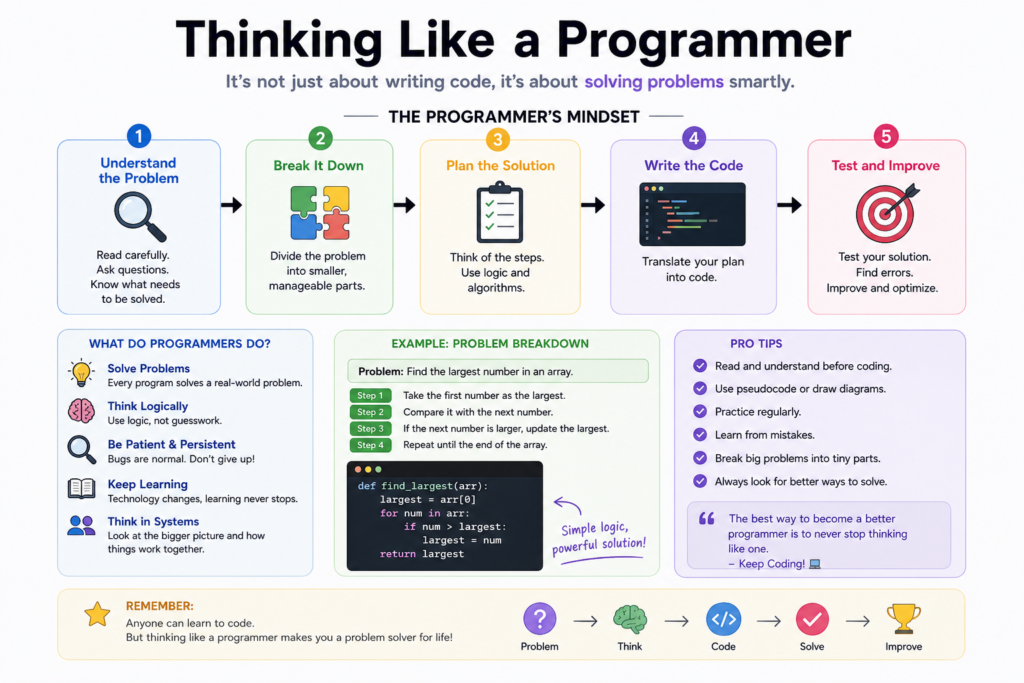

Master the art of thinking like a programmer. Learn how to break down complex problems, build logical frameworks, and code with a professional.
Thinking Like a Programmer: The Ultimate Guide to Master Problem Solving
Have you ever looked at a complex piece of software—like Google Maps or a high-end video game—and wondered, “How on earth does a human mind organize something that massive?” If you’ve started your coding journey, you’ve likely hit that wall where you know the syntax of a language, but you have no idea how to actually solve a problem with it.
You know how to write a “for loop” and you know what a “variable” is, but when you’re faced with a blank screen and a project requirement, your mind goes blank. This is the “Syntax Gap,” and the only bridge across it is learning the art of thinking like a programmer.
In this guide, we aren’t going to talk about semicolons or brackets. We are going to dive deep into the cognitive framework of software engineering. You will learn how to deconstruct chaos, identify patterns, and speak the language of logic. Whether you’re a complete newbie or an intermediate dev feeling stuck, this is the mental upgrade you’ve been waiting for.
What is Thinking Like a Programmer?
At its core, thinking like a programmer isn’t about knowing a specific language like Python or C++. It is a process of Computational Thinking.
Think of it as a specialized form of problem-solving. While a chef looks at a kitchen and sees flavors, and an architect looks at a plot of land and sees structures, a programmer looks at a problem and sees a series of logical steps.
It is the ability to take a vague, messy human desire (like “I want an app that tells me when my coffee is cold”) and translate it into a highly specific, binary set of instructions that a machine can execute without error. It involves four key pillars:
- Decomposition: Breaking big problems into small ones.
- Pattern Recognition: Finding similarities between problems.
- Abstraction: Focusing on what matters and ignoring the noise.
- Algorithmic Thinking: Creating a step-by-step roadmap.
Why is it Important?
Why should you care about the “thinking” part? Can’t you just Google the code?
In the age of AI and Stack Overflow, syntax is becoming a commodity. Anyone can generate a code snippet. However, knowing thinking like a programmer is what makes you a true engineer.
1. Languages Fade, Logic is Forever
Programming languages go in and out of fashion. Fortran gave way to C, which gave way to Java, which gave way to Python. But the logical foundation of how to structure a database or secure a login hasn’t changed in 40 years.
2. Efficiency and Scalability
A programmer doesn’t just want to solve a problem; they want to solve it efficiently. If you don’t think like a programmer, you might write code that works for 10 users but crashes for 10,000.
3. Debugging is 90% of the Job
Writing code is easy; finding out why it’s broken is hard. A logical mindset allows you to trace errors like a detective, isolating variables until the culprit is found.
Core Concepts Explained: The Step-by-Step Framework
How do you actually do it? Let’s break down the mental process into a repeatable framework.
1. Decomposition (The “Divide and Conquer” Method)
If I ask you to “Build a Social Media App,” your brain will likely shut down. It’s too big.
Thinking like a programmer means you break that monster into tiny, manageable chunks:
- How do I let a user sign up?
- How do I store a single post?
- How do I display a list of posts?
- How do I let someone “like” a post?
Now, you aren’t building a social media app. You’re just building a “Like Button.” Anyone can build a button. When you finish 100 tiny tasks, you suddenly realize you’ve built a massive app.
2. The Power of Abstraction
Abstraction is the art of ignoring the “how” to focus on the “what.”
When you drive a car, you don’t think about the internal combustion or the fuel injectors. You think about the steering wheel and the pedals. In programming, you treat complex systems as “Black Boxes.” You know what goes in and what comes out; the messy middle isn’t your concern at that moment.
3. Algorithmic Thinking
An algorithm is just a fancy word for a recipe. It’s a set of instructions. But here’s the catch: computers are literally the most obedient, unintelligent entities on earth. They do exactly what you say.
If your recipe says “Put the bread in the toaster,” but you forgot to say “Take the bread out of the bag,” the computer will try to toast the plastic bag. Thinking like a programmer means being obsessively specific about the sequence of events.
[Image showing a flowchart of an algorithm for a daily routine]
Practical Examples: The “Making a Peanut Butter Sandwich” Test
To test if you are thinking like a programmer, try to write instructions for a robot to make a sandwich.
The Amateur Way:
- Put peanut butter on bread.
- Put jelly on bread.
- Eat.
The Programmer Way: - Identify the location of the bread bag.
- If the bag is sealed with a plastic tie, rotate the tie counter-clockwise until it is removed.
- Reach into the bag and extract exactly two slices of bread.
- Place slices side-by-side on a flat, clean surface.
- Open the jar of peanut butter (Check: Is it a twist top or a pop top?).
- …and so on.
Do you see the difference? The programmer anticipates the “If/Then” scenarios and the physical constraints of the environment.
A Code Example: Finding the Highest Number
Let’s say you have a list of numbers: [12, 45, 7, 89, 23]. How do you find the biggest one?
The Logic:
- Create a variable called max_number and set it to the first item in the list.
- Look at the next number.
- IF the next number is bigger than max_number, THEN update max_number to be this new number.
- Repeat until you reach the end of the list.
- Display max_number.
numbers = [12, 45, 7, 89, 23]
max_number = numbers[0]

for n in numbers:
    if n > max_number:
        max_number = n

print(f"The winner is: {max_number}")
Common Mistakes to Avoid
- Coding Before Thinking: The biggest mistake beginners make is opening a code editor and typing immediately. Professional programmers spend 70% of their time with a pen and paper (or a whiteboard) and only 30% typing.
- Assuming the Best Case Scenario: Beginners assume the user will always type their name correctly. Programmers assume the user will try to type a phone number in the name field, hit “Enter” ten times, and then disconnect their internet.
- The “One-Size-Fits-All” Solution: Don’t get emotionally attached to a specific tool. Just because you know React doesn’t mean every problem needs a React solution.
- Ignoring Edge Cases: What happens if the list of numbers is empty? What if the numbers are negative? Thinking like a programmer means looking for the “edges” where the logic might fray.
💡 Pro Tip: When you’re stuck, use Rubber Duck Debugging. Explain your problem out loud to a literal rubber duck (or a plant, or your cat). In the process of explaining the steps to someone who knows nothing, you will usually find the flaw in your own logic.
Pro Tips & Best Practices
Learn to Love “Pseudo-code”
Before you write Python, write in “Pseudo-code”—a mix of English and code logic. It allows you to solve the problem without worrying about missing a bracket or a colon.
Read Other People’s Code
Go to GitHub and look at popular repositories. Don’t just look at the code; try to figure out why they structured the folders that way. Why did they use that specific naming convention?
Master the Google Search
Part of thinking like a programmer is knowing how to find information. Don’t search “my code doesn’t work.” Search for the specific error message, the version of the library you’re using, and the context of the bug.
Real-World Use Cases
1. Automated Home Systems
Imagine you want your lights to turn on when you get home, but only if it’s after sunset.
- Decomposition: GPS tracking, Sunset API check, Smart light switch toggle.
- Logic: IF distance_to_home < 50m AND current_time > sunset_time THEN lights = ON.
2. Game Development
In a game like Minecraft, the game needs to decide which blocks to show.
- Abstraction: The game doesn’t render the whole world; it only renders the “chunk” the player is standing in. This is a classic example of ignoring unnecessary data to save memory.
3. Logistics and Delivery
Companies like UPS use algorithms to ensure drivers never make left turns (which are slower and cause more accidents). This is algorithmic thinking applied to fuel efficiency and safety.
Mini Project: The “Guess My Number” Game Logic
Let’s practice the mindset. Don’t worry about the code; let’s map out the logic for a game where the computer picks a number between 1 and 100, and you have to guess it.
1. Initialization:
- Generate a random integer secret between 1 and 100.
- Set attempts to 0.
2. The Game Loop:- Ask the user for a guess.
- Increment attempts by 1.
- COMPARE guess to secret.
- IF guess equals secret: Tell them they won and show attempts. END.
- IF guess is less than secret: Tell them “Too low!”
- IF guess is greater than secret: Tell them “Too high!”
- REPEAT the loop.
If you can write this out on paper, you are already thinking like a programmer. The actual code is just a translation of these steps.Frequently Asked Questions (FAQs)
1. Do I need to be a math genius to think like a programmer?
No! Programming logic is more about linguistics and philosophy than it is about calculus. If you can follow a recipe or organize a bookshelf, you can think like a programmer.
2. Can you teach yourself this mindset?
Absolutely. Like a muscle, it gets stronger the more you use it. Start by trying to explain everyday objects (like a vending machine) in terms of “If/Then” logic.
3. Why is it so hard to start?
Because humans are used to “filling in the blanks” with intuition. Computers have no intuition. Learning to stop assuming things and start being explicit is the hardest mental shift.
4. Is “Thinking like a programmer” the same as “Computational Thinking”?
Mostly, yes. Computational thinking is the academic term used in education, while “thinking like a programmer” is the industry term. Both share the same core pillars of decomposition and abstraction.
5. Does AI mean we don’t need this mindset anymore?
Quite the opposite. Tools like ChatGPT are great at syntax, but they still need a “Programmer Mindset” to give them the right instructions (Prompts). You have to know how to break down the problem before the AI can help you solve it.
Conclusion
Thinking like a programmer is a superpower. Once you learn how to break down complex problems and approach them with a structured, logical framework, you’ll find that it doesn’t just help with code—it helps with everything in life. From planning a vacation to managing a budget, the world becomes a series of solvable puzzles rather than an overwhelming mess.
Remember: No one is born knowing how to do this. It is a skill built through thousands of “Trial and Error” moments. Every time you fix a bug or struggle with a logic puzzle, your brain is rewiring itself to see the world a little more clearly.
The journey from a “syntax copier” to a “logical creator” is long, but it is the most rewarding path you can take in tech.
Start practicing now! Pick one thing in your house—your microwave, your thermostat, or your alarm clock—and try to write down the “Programmer Logic” for how it works. Once you start seeing the logic in the world around you, you’ll never see it the same way again.
Check our next guide on “Mastering Data Structures” to see how programmers organize information!